Practical Coping Skills for Anxiety That Help

Your heart is beating faster than the situation seems to warrant. You reread the same email three times, imagine every possible outcome of a conversation, or feel tense before your feet even touch the floor in the morning. Anxiety can make ordinary demands feel urgent and uncertain. Practical coping skills for anxiety will not erase every hard feeling, but they can help you create enough space to choose your next step rather than being pulled along by the alarm.
The most helpful skills are usually simple, repeatable, and suited to the moment you are in. What works when you are lying awake at night may be different from what helps before a presentation, during an argument, or when parenting pressures are piling up. The goal is not to do every strategy perfectly. It is to notice what helps you feel a little more grounded, clear, and connected to yourself.
Start by calming the body
Anxiety is not only a pattern of thoughts. It is also a physical response. Your nervous system may be preparing you to deal with danger, even when the danger is a deadline, an unanswered text, or a difficult decision. Trying to reason your way out of anxiety before your body has settled can feel frustrating.
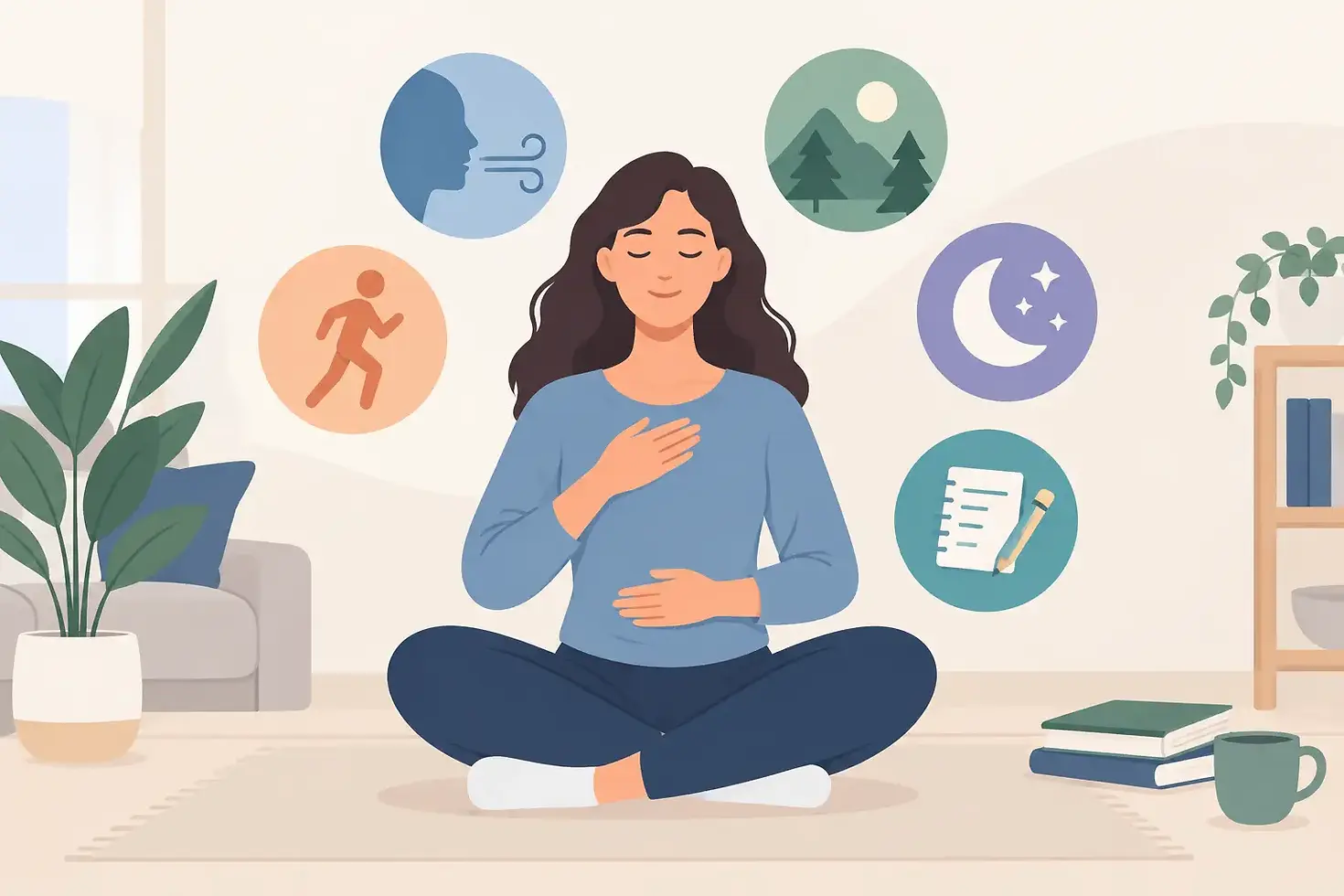
Begin with a slower exhale. Breathe in gently through your nose, then let your exhale be a little longer than your inhale. There is no need to force a deep breath, which can sometimes make you feel more aware of uncomfortable sensations. A few calm, unhurried breaths can signal to your body that it does not need to stay on high alert.
You can also use your senses to reconnect with the present. Notice the pressure of your feet against the floor, the temperature of a drink in your hands, or five objects you can see around you. Name what is actually here: “I am sitting at my desk. It is Tuesday afternoon. I have one task in front of me.” This does not dismiss what is worrying you. It helps your mind distinguish between a thought about the future and what is happening right now.
Movement can be useful, too. A short walk, stretching your shoulders, shaking out your hands, or stepping outside for a few minutes gives anxious energy somewhere to go. If you are feeling highly activated, stillness may not be the best first choice. It depends on your body and the situation.
Practical coping skills for anxiety in everyday moments
Anxiety often grows when everything feels equally urgent. A practical response is to make the next step smaller. Instead of asking, “How will I handle all of this?” ask, “What is one thing I can do in the next 10 minutes?” That might mean opening the document, loading the dishwasher, sending one message, or writing down the appointment you need to book.
A brief check-in can help you sort out what needs attention. Try asking yourself: What am I feeling? What am I worried will happen? What is within my control today? These questions can turn a vague sense of dread into something more specific and manageable.
It can also help to place limits around worry. If your mind repeatedly circles the same concern, write it down and set aside a short time later in the day to think it through. When the thought returns, gently remind yourself, “I have made space for this. I do not have to solve it this second.” This is not avoidance. It is a way of keeping worry from taking over every moment.
For many people, reducing stimulation is another meaningful skill. Turn off nonessential notifications, take a break from scrolling, or give yourself a few quiet minutes between work and family responsibilities. Constant input can make it harder to recognize what you need. A small pause may be enough to help you respond with more intention.
Work with anxious thoughts, not against them
Anxious thoughts often sound convincing because they focus on possibilities that matter to you. “If I make a mistake, everyone will think I am incompetent.” “If my partner seems quiet, something must be wrong.” “If I feel this anxious, I will not be able to cope.” The thought may feel true, but feelings are not always facts.
Rather than arguing with yourself, try adding a little distance. You might say, “I am noticing the thought that I will fail,” or “My anxiety is predicting the worst-case scenario.” This wording reminds you that a thought is an experience your mind is having, not necessarily a reliable forecast.
Then look for a more balanced statement. A balanced thought is not forced positivity. It makes room for uncertainty and your ability to cope. For example: “This meeting may be uncomfortable, but I can prepare and ask for clarification if I need it.” Or: “I do not know why they are quiet. I can check in rather than assume.”
If you are supporting a teen, it can be tempting to quickly reassure them that everything will be fine. Sometimes a more helpful response is, “That sounds really stressful. What part feels hardest right now?” Feeling understood can lower defensiveness and make room for problem-solving.
Build a routine that gives anxiety less room to run
Coping skills are more effective when they are practiced before anxiety peaks. You do not need a rigid wellness routine to care for your mental health. Small anchors can make a real difference: eating regularly, getting enough rest when possible, moving your body, spending time with people who help you feel like yourself, and making room for activities that are not about productivity.
Pay attention to patterns without judging yourself. Caffeine, missed meals, lack of sleep, alcohol, conflict, and overcommitting can all increase anxiety for some people. This does not mean you have to eliminate every stressor or follow a perfect schedule. It means you can learn what leaves you more vulnerable and make supportive adjustments where you can.
Boundaries are part of anxiety care, too. Saying no to one extra commitment, asking for more time, or being clear about what you can realistically take on may bring temporary discomfort. Yet constantly pushing past your limits often keeps your nervous system in a state of overload. A boundary can be a practical act of self-respect.
Know when to reach out for support
Self-help strategies can be valuable, but you do not have to manage anxiety alone. It may be time to speak with a counselor if worry is affecting sleep, work, school, relationships, parenting, or your ability to enjoy daily life. Support can also be helpful when you understand the tools but find it difficult to use them in the moments that matter most.
Counseling offers a place to slow down and understand what anxiety is responding to. Together, you can identify patterns, build coping and communication skills, and develop strategies that fit your life rather than someone else’s idea of what should work. If anxiety feels overwhelming, includes panic symptoms, or brings thoughts of harming yourself, seek immediate crisis or emergency support in your area.
You do not need to wait until anxiety reaches a breaking point to deserve support. One small practice, repeated with patience, can become a steady reminder: you can meet this moment, and you can take the next step.


Comments